

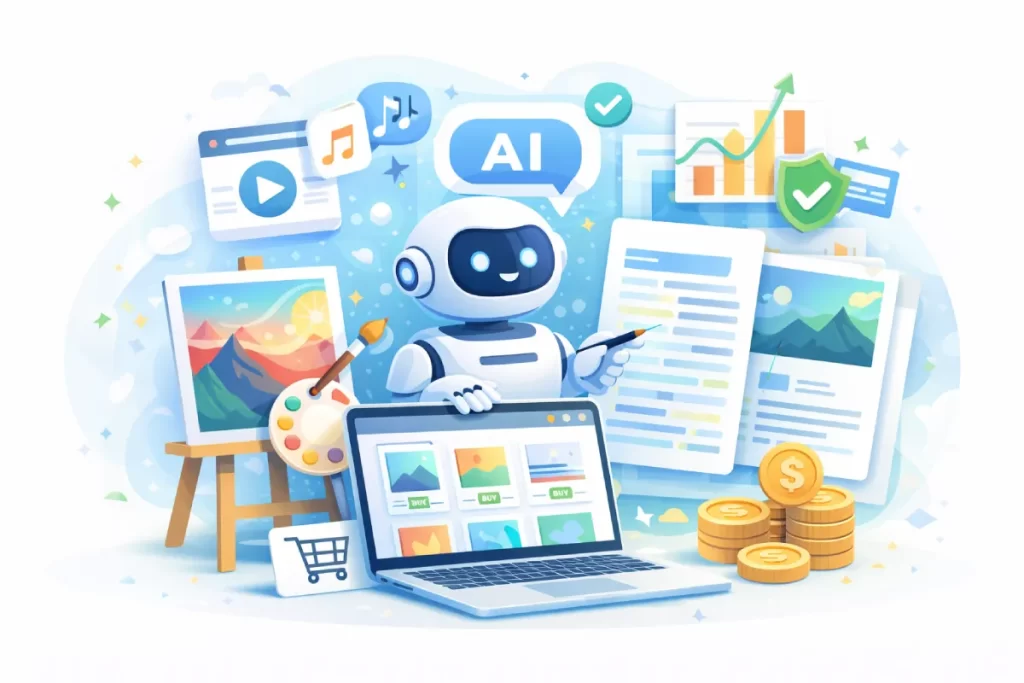
The digital product economy is undergoing a seismic shift. Artificial intelligence tools like ChatGPT, Midjourney, DALL·E, and a growing ecosystem of specialized AI platforms have made it possible for anyone to generate eBooks, design templates, stock graphics, code libraries, music, and more — in minutes rather than weeks.
For digital product sellers who have built their livelihood around digital downloads, this raises urgent questions: Is AI-generated content devaluing the market? How do you compete when production costs approach zero? And most importantly — how can you use AI to your advantage instead of being disrupted by it?
What’s Driving the AI-Generated Digital Products Boom
The numbers tell the story. Every major digital marketplace is seeing a surge in AI-generated listings — from Etsy printables to stock photo sites to WordPress theme directories. The barriers to creating and selling digital products have never been lower.
Here’s what’s driving the trend:
- Text generation — AI tools can produce eBooks, guides, documentation, course materials, and marketing copy at scale. A seller can outline a topic and have a full manuscript drafted in hours.
- Image and design generation — AI tools like Midjourney and Stable Diffusion create illustrations, icons, UI kits, social media templates, and product mockups that would have taken a designer days to produce.
- Code generation — AI coding assistants can scaffold plugins, themes, scripts, and automation tools, drastically reducing development time for software products.
- Audio and video — AI-generated music, voiceovers, and video content are becoming increasingly indistinguishable from human-produced alternatives.
According to McKinsey’s research on generative AI, artificial intelligence could add trillions of dollars in value across industries, and the creative economy — including digital asset creation and distribution — is among the most affected sectors. The result is a flood of new products entering every digital storefront. And while quantity is exploding, quality varies wildly.
The Real Impact on Digital Product Sellers
If you sell digital products — whether that’s WordPress plugins, design assets, educational content, or software tools — here’s what you’re likely noticing:
1. Increased Competition in the Digital Marketplace
Artificial intelligence has dramatically lowered the floor. Someone with no design experience can now produce passable social media templates. A non-developer can generate a basic WordPress plugin. This means the low-cost, commodity end of every digital product category is getting crowded fast.
If your products compete primarily on price, this is a direct threat. There will always be someone who can produce a “good enough” alternative for less — or free.
2. Buyers Are Getting Smarter About AI Content
As AI-generated digital products flood the market, buyers are learning to distinguish between low-effort AI output and genuinely useful products. Reviews, ratings, and reputation matter more than ever. Buyers are asking: Was this actually tested? Does the seller provide support? Is this a real product or just AI output with a price tag?
3. The Value Has Shifted Away from Production
When production becomes cheap, other things become valuable: curation, expertise, support, integration, and trust. The digital seller who deeply understands their customer’s problem and delivers a complete solution — not just a generated file — is the one who wins.
How Digital Sellers Can Compete (and Win) in the AI Era
The good news: AI doesn’t eliminate the need for digital products. It changes what makes a product worth paying for. Here’s how to position yourself on the right side of that shift.
Use AI Tools as Accelerators, Not Replacements
The most successful digital product sellers in 2026 aren’t avoiding AI — they’re using AI tools to accelerate their workflow while adding their own expertise on top. Use artificial intelligence to draft content faster, generate design variations, scaffold code, or automate repetitive tasks. Then apply your knowledge to refine, test, and polish the output into something genuinely valuable.
A WordPress developer who uses AI to speed up plugin development but still manually tests, optimizes performance, and writes clear documentation is producing a fundamentally different product than someone who just ships raw AI output.
Sell Outcomes, Not Just Digital Downloads
The era of selling a standalone PDF or template pack and walking away is fading. Buyers increasingly want outcomes: a working solution, a complete workflow, a product that actually solves their problem without requiring them to figure out the rest.
Bundle your digital products with:
- Clear documentation and setup guides
- Video walkthroughs
- Ongoing updates and version management
- Customer support
- Integration with popular tools and platforms
If you’re using WordPress Download Manager, you already have the infrastructure to deliver versioned products with changelogs, license management, and access control — features that signal professionalism and build buyer confidence.
Build a Brand Around Your Digital Storefront
In a digital marketplace where anyone can generate a product, your brand becomes your moat. Consistent quality, a recognizable style, responsive support, and a track record of reliability are things AI can’t replicate.
Invest in your digital storefront. Use professional product pages with detailed descriptions, screenshots, and changelogs. Maintain a blog that demonstrates your expertise. Engage with your customers. These signals tell buyers that a real person stands behind the product.
Focus on Niches AI Doesn’t Serve Well
AI tools excel at generating generic content. They struggle with:
- Industry-specific solutions — Digital products tailored to specific verticals (legal, medical, real estate) require domain knowledge that generic AI doesn’t have.
- Complex integrations — Plugins and tools that connect multiple systems require real engineering and testing.
- Localized content — Products adapted for specific regions, languages, or regulatory environments.
- Curated bundles — Thoughtfully assembled collections that work together, rather than random generated digital assets.
The more specific and context-dependent your product is, the harder it is for artificial intelligence to commoditize it.
Automate Your Digital Product Operations
While AI changes the product side, automation changes the business side. Digital sellers who automate their delivery, licensing, customer communication, and analytics can operate more efficiently and focus on what matters — building better products.
Key areas to automate:
- Product delivery — Automatic download access after purchase with expirable links and access control.
- License management — Automated license key generation, domain validation, and renewal tracking.
- Version updates — Push updates to customers automatically with changelogs and release notes.
- Customer communication — Automated order confirmations, download instructions, and follow-up emails.
- Analytics — Automated sales reports and download tracking to understand what’s working.
WordPress Download Manager’s Premium Packages add-on handles most of these automation tasks out of the box — from payment processing and order management to license management and access control.
Digital Asset Management in the Age of AI
As AI-generated content multiplies, digital asset management becomes more important than ever. Sellers managing hundreds or thousands of digital products need systems that can organize, version, distribute, and track their assets effectively.
Effective digital asset management for AI-era sellers includes:
- Organized file libraries — Categorize digital downloads with proper taxonomies, tags, and metadata so customers can find what they need.
- Version control — Track changes across product versions, especially important when AI assists in generating updates.
- Access control and licensing — Ensure the right customers can access the right digital assets with proper license management and expiration rules.
- Analytics and reporting — Monitor which digital products perform best and where to invest your time next.
A solid digital asset management workflow, paired with automation, lets you scale your digital storefront without scaling your workload proportionally.
The Ethical Dimension of AI-Generated Products
It’s worth addressing the elephant in the room: transparency. Buyers increasingly care about whether digital products were AI-generated, and some marketplaces are starting to require disclosure. The FTC has issued guidance on AI-related marketing claims, signaling that regulators are paying attention too.
Our recommendation: be upfront. If you used AI tools as part of your creation process, say so. Most buyers don’t mind — they care about whether the product works, not how it was made. But they do mind being misled. Honesty builds trust, and trust is the most valuable currency in digital commerce.
What’s Coming Next for Digital Product Sellers
Looking ahead, several trends are likely to shape the digital product landscape:
- AI-assisted personalization — Digital products that adapt to individual buyer needs at the point of sale. Imagine a template pack that auto-customizes to the buyer’s brand colors and logo.
- Quality verification — Digital marketplaces and platforms will develop better tools for verifying product quality, penalizing low-effort AI spam and rewarding genuine value.
- Subscription and update models — One-time digital downloads will continue shifting toward subscriptions where digital sellers provide ongoing value through updates, new content, and support.
- Hybrid products — The most successful digital products will combine AI-generated components with human expertise, curation, and quality assurance.
The Bottom Line for Digital Sellers
AI isn’t killing the digital product market — it’s restructuring it. The digital sellers who treat artificial intelligence as a tool in their workflow, focus on delivering genuine value, and invest in their brand and customer relationships will thrive. The ones who try to compete on volume alone, shipping unrefined AI output at rock-bottom prices, will find themselves in a race to the bottom.
The opportunity has never been bigger for digital product sellers willing to adapt. Use AI tools to work faster. Use automation to work smarter. And never stop focusing on what your customers actually need.
Ready to sell digital products on your own terms? WordPress Download Manager gives you everything you need to sell, deliver, and manage digital downloads on WordPress — with built-in support for licensing, version control, digital asset management, and more.
